 Billed as “the superhero origin story of Shakespeare’s Henry V”, this is a production filled with confident zeal but sadly doomed to fail as spectacularly as the French defeat at Agincourt.
 For some, the prospect of a superhero-themed (or at any rate costumed) take on Shakespeare may seem like a juvenile and ill-conceived bit of university dramatic society-style hucksterism. Indeed, it is hard not to regard it as a somewhat superficial bid to appeal to those more likely to patronise a multiplex than a playhouse. To be fair though, if you have watched a lot of productions of Shakespeare’s plays over the last few decades, anywhere from schools and small independent co-ops right through to high-concept extravaganzas by leading theatre companies, you would be hard pressed to say this is honestly the worst idea that you’d ever seen for setting the Bard’s work in a flashy new milieu in an attempt to garner attention.
Because the truth is, at least in this country, that unless you go overseas to the historical recreation performances at the Globe Theatre, there really is no such thing as “traditional Shakespeare” anymore. When it comes to production design and directorial concepts, every Shakespeare play you are going to see is staged in some kind fantastical, anachronistic, cross-referential, metatextual, or otherwise esoteric setting. Be it placing Twelfth Night in a suburban Australian backyard, a surreal hellscape version of Macbeth populated by little people, Richard III as Mosley-esque early 20th Century fascists, envisioning A Midsummer Night’s Dream as an erotic clown carnival, a Kafka-meets-David-Lynch approach to King Lear, setting Henry IV in a post-apocalyptic urban sprawl, or “updating” Henry V specifically to the first World War… today Shakespeare is always a desperate scramble to be fleetingly innovative, attention-grabbing, somehow notionally “original”. It is a perpetual attempt to use external cultural reference points to try and convince audiences, particularly young people, that these plays which have been performed thousands of times before merit new attention.
One could at this point easily get drawn into a debate over whether this ubiquitous approach of trying to find “relevance” (or at any rate, gimmicks) for new productions of Shakespeare is interpretatively liberating or a creative crutch, but that is a larger topic. Superhal draws upon the imagery of superheroes, currently the most dominant genre in mainstream entertainment, as an aesthetic veneer for presenting these plays which are, at their core, concerned with the illusory and manipulable nature of heroism and constructed, often false, identities. It may not be brilliantly insightful, but suffice it to say that this is hardly the shallowest nor most thematically spurious basis for an outlandish production design concept I’ve ever seen for a rendition of Shakespeare.
Unfortunately, it is not the concept which lets this production down, but the execution of that concept, as well as virtually everything else…
Personally, I have not seen any prior work by The Puzzle Collective, but between having earlier visited both a modestly-attended yet entertaining fundraiser variety show at the Red Rattler for this production, and then sighted some expensive-looking ads on the backs of a few taxis, it was difficult to calibrate expectations for this company’s level of professionalism. The resulting high-concept show, performed to a tiny opening night audience dwarfed by NIDA’s cavernous Parade Theatre, proved to be easily the least professional event I have attended at this venue. Moreover, it was one of the most woefully amateurish pieces of live theatre I have seen in recent memory, and quite possibly the worst production of Shakespeare I have ever reviewed in my career as a critic.
It is sad to be compelled to say this, because there are some things to like here. The conflation of Shakespeare’s three narratively continuous plays, Henry IV parts one and two plus Henry V, into two acts, is, although hardly innovative, is not a poorly edited arrangement of the texts for a simplified staging of these epic works. A few of the costumes are reasonably impressive and visually striking, and several of the actors are quite solid, albeit none outstanding. Cross-casting some of the roles helps gender-balance the cast somewhat, and on balance the women were stronger actors in the company than the men, particularly Amanda Maple-Brown and Emily Weare.
Fortunately, the lead actor Richard Hilliar is actually rather good, and by far the best in the show. He plays the many different shades of Prince Hal’s dissembling persona as a wastrel to mask his higher calling, before evolving through the crucible of civil war to become King Henry the Fifth, self-styled hero of England set to embark on foreign conquest. Hilliar’s performance has nuance and charm, continuing to impress with not only his command of the material but also his dramatic turns, becoming every inch the inspiring leader from less than auspicious beginnings. He delivers some of Shakespeare’s most rousing battlefield speeches with not inconsiderable aplomb, only to become disarmingly nervous and awkward in the dénouement when attempting to woo his prospective French wife.
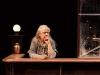
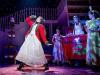
Unfortunately, no single strong performance, not even one more powerful than a locomotive, could hope to salvage a trainwreck of a show such as this. While Hilliar and a few others might have been able to offset the more middling of their cast-mates, nothing could mask the truly dire performances of a few struggling actors. Most notably bad was David Attrill as Hal’s father Henry IV, who painfully shambled through his lines, actually forgetting them more than once. And although I have already praised “a few” of the costumes, the bulk were insipid attempts to cobble together generic sci-fi elements that barely evoked the superhero aesthetic that was the cornerstone of the production. Much of the costume and scenic design was achieved with highly inconsistent levels of quality, and multiple apparent breakdowns of their limited electronic features appeared midway through the performance.
Indeed, woeful inconsistency would seem to be the most accurate way to describe this production, were it not for the fact that some aspects were consistently awful. The choreography was stilted and embarrassing, with superhero-inspired battle scenes that were clearly intended to be climactic spectacles for the production looking instead like hastily improvised high school drama club fare. Set adjustments would be misaligned and fumblingly corrected, while actors would miss their cues, begin their entrances too early, and were completely unaware of being visible in the wings to those viewing from the outer rows.
Worst of all was the horrendous incompetence which beset the sound and lighting operation, with ill-timed music cues throughout, including initially drowning out most of Hilliar’s delivery of Henry’s iconic monologues before abruptly plunging the volume down mid-sentence, in a succession of clearly panicked technical gaffes. The kindest benefit of the doubt one can give is in imagining the production may have been beset by some kind of backstage crisis causing an almost inconceivable lack of technical rehearsal, but that is ultimately no excuse when the final product is so excruciatingly substandard.
Even if this scenario is true, however, it would do little to explain the production’s many other shortcomings, most of which must surely be laid at the feet of director John Galea. Actors of variable quality can be difficult to make gel, understandably, yet this cast felt disconnected on a more basic level than on that of their skills as thespians. There was a fundamental lack of chemistry between the cast, who seemed quite at sea as to how to inhabit scenes together, with even individually adequate performances having no flow or cohesion with each other. It was as though all the actors had developed their characterisations and delivery in isolation, yet been afforded no opportunity nor guidance in developing any rapport whatsoever as an ensemble working in common cause.
Between this profound sense of dissonance among the cast, unimaginative staging, sub-community-theatre-standard use of blackout scene-changes, and dire choreography, one can only conclude that this production lacked any form of competent direction, or at best was helmed by a director whose ambitions for a staging of this complexity far outstripped his modest abilities. Quite frankly I was left wondering how a production of this low calibre came to be in a position to hire such a large and relatively illustrious venue, and cannot help but suspect that the show’s very existence is testament to an enthusiastic marketing campaign and an oversupply of goodwill generated by its populist core concept.
Superhal is a show which aimed high but spasmodically teetered almost immediately off the nearest cliff; a cute idea with an appealing lead which ultimately collapsed under the weight of its own manifest ineptitude.
The Puzzle Collective presents
SUPERHAL
by John Galea
Directed by John Galea
Venue: NIDA Parade Theatre, 215 Anzac Parade, Kensington NSW
Dates: 7 –18 March 2017
Tickets: $45.85 – $35.65
Bookings: www.thepuzzle.com.au